
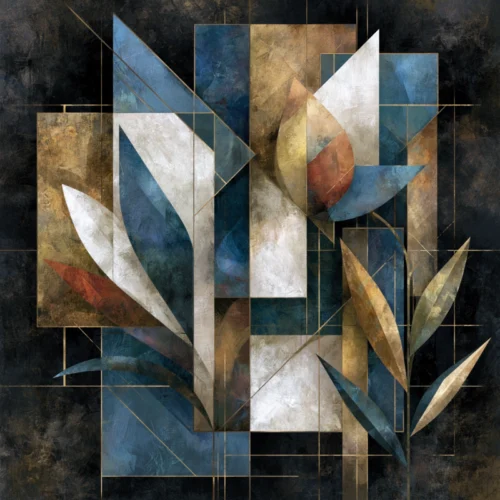
A room can be beautifully furnished and still feel unfinished. Often, what is missing is not another object, but an image with enough visual authority to gather the space around it. The most compelling statement art trends 2026 are moving decisively in that direction: away from passive decoration and toward artwork that establishes mood, memory, movement, and point of view.
For collectors and design-minded homeowners, this shift is welcome. Statement art is no longer synonymous with simply choosing the largest piece that fits above the sofa. It is about selecting work with an inner life – art that continues to reveal itself through color, texture, gesture, and atmosphere. In interiors that increasingly favor individuality over formula, art is becoming the element that makes a room unmistakably its own.
Statement Art Trends 2026: Presence Over Perfection
The polished, carefully coordinated interior has not disappeared, but it is becoming less rigid. Rooms are gaining softness, contrast, and evidence of the people who inhabit them. A sculptural chair may sit beside an inherited table. Plaster walls may frame contemporary photography. A quiet palette may be interrupted by one field of saturated crimson, cobalt, or luminous gold.
Statement art belongs naturally in this more layered approach. Rather than matching a room, the strongest work creates a productive tension within it. An abstract composition can bring velocity to restrained architecture. Floral imagery against a dark ground can add drama without becoming literal. A photograph transformed through digital manipulation can hold the familiarity of the visible world while carrying the surprise of a dream.
This is why visual presence matters more than decorative perfection. The right piece does not need to repeat every color in the rug or echo every material in the room. It needs to make the eye pause. It needs to give the space an emotional center.
Color Returns With Greater Confidence
Neutral interiors remain enduring for good reason: they create air, calm, and architectural clarity. Yet 2026 is less interested in neutrality as an endpoint. Color is returning as an experience, particularly in artwork where it can be felt as light, depth, and energy rather than as a simple accent.
Deep botanical greens, electric blues, ember oranges, magentas, and richly modulated blacks are especially powerful when they appear in expressive compositions. These hues bring an immediate sensory charge to plaster, linen, oak, stone, and other natural finishes. They also allow an interior to feel collected rather than cautiously coordinated.
The trade-off is scale and placement. A highly saturated work in a compact room can be transformative, but it needs visual breathing room. Let the image lead rather than surrounding it with competing objects. In a larger open-plan setting, color can carry even more weight, creating a focal point that gives expansive architecture a sense of intimacy.
Texture Is Becoming Visual, Not Just Tactile
Interiors have embraced tactile materials for several seasons: boucle, wool, raw wood, handmade ceramic, brushed metal. The next expression of that desire for texture is increasingly visual. Collectors are drawn to art that appears to hold atmosphere within its surface – blurred motion, layered pigment-like forms, photographic grain, veils of light, and intricate passages that resist a quick glance.
This is where digitally reinterpreted photography has particular resonance. It can begin with the truth of a lens-based image, then move beyond description into something more intuitive. A flower ceases to be merely a flower. Water becomes movement. A remembered landscape becomes a field of color and emotion. The resulting work brings complexity to a wall without requiring a room to become crowded.
In minimal interiors, this kind of visual texture can be especially effective. One richly layered print above a low, quiet console may offer more depth than a shelf filled with decorative objects. In more maximal spaces, it can become a counterpoint, giving the eye a place to settle even as the composition continues to unfold.
The Rise of the Immersive Image
Large-scale art remains central to statement art trends in 2026, but the reason is evolving. The appeal is not size for its own sake. It is immersion. A substantial work changes the perceived proportions of a room, drawing the viewer into an image rather than asking them to observe it from a distance.
For a high-ceilinged entry, a generous horizontal work can set a confident tone before a word is spoken. In a dining room, a vertical composition can introduce lift and ceremonial presence. In a bedroom, a large artwork with softened forms or meditative color can create a private horizon, changing the feeling of the room at the beginning and end of each day.
The practical question is not whether a piece is “too large,” but whether it has enough space around it to register. Art that is undersized can feel apologetic. Art that is appropriately scaled can make even a modest room feel intentional. Measure the available wall, certainly, but also consider the viewing distance, the ceiling line, and the emotional volume of the image.
Diptychs and Triptychs Create Rhythm
Multi-panel work is gaining renewed attention because it offers something a single image cannot: rhythm. A diptych can suggest dialogue, reflection, or a change in perspective. A triptych can create a visual sequence, allowing color and form to move across a wall with a measured, architectural grace.
These formats are especially suited to long walls, stair landings, hospitality interiors, and contemporary offices, where a single frame may feel isolated. Yet they are not merely a solution for large spaces. A pair of related images over nightstands, or a three-panel composition in a narrow corridor, can make transitional areas feel considered rather than overlooked.
The key is cohesion without repetition. Panels should feel connected by palette, motion, subject, or atmosphere, while each retaining a distinct visual pulse. When that balance is achieved, the wall feels less decorated than composed.
Art That Carries a Personal Temperature
A notable change in collecting is the desire for art that feels emotionally specific. Buyers are less interested in choosing a piece solely because it is broadly pleasing. They want work that reflects a response: exhilaration, stillness, sensuality, nostalgia, mystery, or the sense of having encountered something just beyond language.
This does not mean every piece needs to tell a literal story. In fact, ambiguity is often part of its power. Abstract art and transformed photographic imagery leave room for the viewer. They can recall a garden at dusk, a city reflected in rain, a place never visited, or a memory without a fixed narrative. Over time, that openness allows a work to remain alive in the home.
For interior designers, this is an invitation to begin with the desired emotional temperature of a room rather than its color scheme alone. Ask whether the room should feel contemplative or kinetic, intimate or expansive, luminous or dramatic. The answer may lead to a floral work on black, a fluid abstract, or a composition that balances recognizable imagery with expressive distortion.
What to Resist When Choosing Statement Art
There is one temptation worth avoiding: selecting art only for its immediate visual impact. A piece may photograph well, follow a popular palette, and still lose force once it becomes part of daily life. Statement art should hold attention beyond the first impression.
Avoid treating artwork as a finishing accessory. Begin with it when possible. Let one extraordinary image influence the room’s direction, whether through contrast, atmosphere, or scale. This approach does not demand that every furnishing coordinate with the artwork. It asks that the room acknowledge it.
It also helps to resist overfilling the wall. A strong print needs space to speak. If a composition is vivid, complex, or emotionally charged, its neighboring surfaces can remain quieter. This is not restraint for restraint’s sake. It is how visual intensity becomes legible.
Arthur Jacob Impressions approaches this territory through images that begin in observation and arrive somewhere more imaginative: photographic reality reshaped into color, motion, texture, and impression. That transformation is precisely what gives contemporary statement art its enduring appeal. It offers more than a scene. It offers a way of feeling inside a space.
The most memorable rooms in 2026 will not be those that follow every visual cue. They will be the rooms that make room for an image with conviction. Choose the artwork that keeps calling you back, then let it set the tone for everything that follows.
View the different collections of Original Fine Art Prints created by Arthur Jacob
Leave a Reply