
A room can be beautifully furnished and still feel unfinished. Often, what is missing is not another object but a point of view: an image with enough presence to draw the eye, change the atmosphere, and remain interesting after the first glance. That is why buy original art prints is a question worth asking when you want walls to feel considered rather than merely filled.
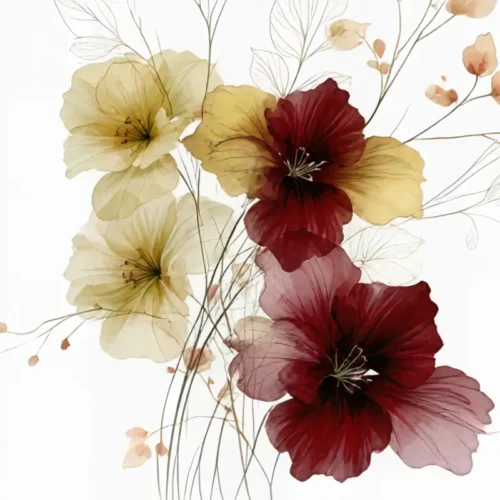
An original art print carries the sensibility of an artist into the spaces where life actually unfolds. It can hold the luminous movement of a floral form, the drama of blossoms against black, or the layered abstraction of a remembered place. Rather than functioning as a decorative afterthought, it becomes part of the room’s emotional architecture.
Why Buy Original Art Prints Instead of Generic Decor?
Mass-produced wall decor is designed to be broadly acceptable. Its colors are often softened, its subjects familiar, and its visual language intentionally neutral. That can be useful when a space needs to recede, but it rarely gives a room its identity.
Original art prints begin elsewhere: with an artist’s observation, intuition, and process. In photographic and digitally reimagined work, the camera may be the starting point, but it is not the final word. Light, texture, color, motion, and form can be transformed until the image becomes an impression rather than a simple record of what stood before the lens.
This distinction matters. A print based on original artwork brings an authored visual language into your home, office, or hospitality setting. It reflects choices that cannot be reduced to a trend forecast: where the composition breathes, where color intensifies, what details dissolve, and what feeling is allowed to surface. The result is art that can feel immediate while continuing to reveal itself over time.
For collectors, this connection to authorship is central. For designers and homeowners, it is equally practical. An artist-led print gives a space a more distinctive focal point without requiring the room to become formal or precious.
Original Does Not Always Mean One of One
The language of art prints can be confusing, especially for buyers who are more interested in visual impact than art-world terminology. An original art print is not necessarily a one-of-one object made by hand in a single moment. It may be a fine art print created from an original photograph, digital composition, or mixed visual process developed by the artist.
What makes it original is the creative source. The image was conceived and made through the artist’s own practice, rather than selected from a generic image library or copied from another work. In Arthur Jacob Impressions, a click becomes a vision and impression: lens-based imagery is reworked into expressive art with a painterly sense of color, movement, and atmosphere.
This also means that a print can be collectible and approachable at the same time. You are not purchasing a visual cliché repeated without context. You are choosing a work grounded in a particular artistic hand, one that can participate in a wider collection or stand on its own.
Art Changes the Feeling Before It Changes the Room
The best wall art does more than coordinate with a sofa or echo a rug. It establishes a mood. A vivid abstract can bring velocity and confidence to an entryway. A luminous floral work can soften the clean lines of a contemporary dining room. A dark, saturated composition can give a bedroom a sense of intimacy and pause.
This is where original art prints offer unusual versatility. Because they are rooted in an artist’s interpretation, they can carry several emotional notes at once. A blossom may read as elegant from across the room, then reveal a feeling of energy and impermanence up close. An abstract may introduce a striking palette while remaining open enough to live with changing furnishings and seasons.
The right work does not need to match every element in a room. In fact, art that matches too perfectly can disappear into the scheme. Often, the more compelling choice is a print that creates a productive tension: a burst of cobalt in a quiet neutral room, a black ground that gives pale interiors depth, or a fluid image that offsets strict architectural lines.
A Strong Print Gives a Space Its Center
Design-conscious interiors need moments of visual hierarchy. Without them, even excellent materials and furniture can compete for attention. Artwork provides a natural center of gravity, guiding the eye and making the rest of the room feel more intentional.
Scale plays a decisive role. A small work can be intimate and jewel-like, particularly in a hallway, reading nook, or grouped arrangement. A larger statement piece can alter the perceived proportions of a room, making an open wall feel purposeful rather than vacant. Diptychs and triptychs offer another possibility: they create rhythm across a longer wall and allow an image to unfold in stages.
There is no universal formula. A dramatic multi-panel work may be ideal behind a reception desk or above a long console, while a single floral print may bring needed focus to a quieter residential corner. The question is not simply, “What will fit?” It is, “What kind of presence does this room need?”
The Value of Living With an Artist’s Perspective
Original art prints reward repeat attention. Unlike decor chosen only for color compatibility, they often hold visual complexity that meets you differently from day to day. A shift in afternoon light can pull out a new tone. A familiar curve can begin to resemble a landscape, a gesture, or a memory. That evolving relationship is one of the quiet pleasures of collecting art.
This is particularly true of work that reinterprets reality. When photography is fused with digital manipulation, it can move beyond documentation into a more subjective territory. The image may retain the physical truth of petals, water, architecture, or light, yet become something less literal and more resonant. It leaves room for the viewer’s own associations.
For professional interiors, this depth matters as well. Art in an office, boutique hotel, wellness space, or client-facing environment can signal discernment without becoming overly didactic. It creates a visual experience that guests and clients can enter immediately, whether or not they know anything about photography or contemporary art.
When an Original Print Is the Right Choice
Original art prints are especially well suited to people who want their interiors to feel personal but not overly prescribed. They work for the seasoned collector seeking a fresh visual voice, the designer building an expressive scheme, and the homeowner ready to move beyond safe wall decor.
That said, they are not the answer to every wall. In a highly utilitarian space, a restrained image may serve better than a bold statement. In a room already filled with pattern, texture, and color, a quieter composition may create balance. Originality does not require visual noise. Sometimes the most powerful work is the one that offers stillness, a dark field, a softened edge, or a single concentrated bloom.
Choose according to the feeling you want to return to. Consider the room at different times of day, the sightline from which the work will first be seen, and the emotional temperature of the colors. A print should not merely occupy the wall. It should give the wall a reason to be there.
Let the Work Speak Before You Explain It
The most enduring art choices usually begin with a genuine response. You may be drawn to a surge of color before you can name why, or to the quiet mystery of an image that refuses to become fully literal. Trust that initial recognition, then give it the practical consideration it deserves in scale, placement, and surrounding materials.
A well-chosen original art print does not ask a room to become a gallery. It allows everyday life to acquire a little more depth: a morning coffee beneath a field of color, a pause in a corridor, a conversation that begins with an image. Choose the work that continues to ignite the senses, and let it become part of the life unfolding around it.
Check out the different collections of original fine art created by Arthur Jacob
Leave a Reply